Tag: music

The instruments I return to when a song is finding its shape

There are sounds I return to when a song is still a soft outline, not yet speaking but listening. Certain instruments feel like rooms I know how to inhabit—places where I can hear the air move and understand which way the feeling wants to travel. They aren’t props to decorate a melody; they are companions. They help me notice what the song is asking for.

Piano is my first doorway. Not the showy kind—the quiet, honest one. A piano keeps time with the heart rather than the clock. Its weighted keys remind me that melody is a kind of gravity: each note falling into its own moment, nothing rushed, nothing withheld. I love the space it creates between touch and bloom, the way a chord can hold a thought steady just long enough for it to become true.

Cello is breath turned into amber. It begins where the voice deepens and the body sighs. When a song needs warmth without sentimentality, I reach for that tenor earth—the long, human arc of a bowed line that can carry grief and grace in the same gesture. Cello doesn’t cry; it consoles. It draws a horizon and gently widens it.

Voice is the instrument that chose me. Not only the sung line, but the near-whisper, the held note, the exhale. Sometimes the most faithful harmony is a second version of the self, tucked an octave below or above, tracing the melody like a hand on a shoulder. Stacked and soft, voices become weather. They can clear a sky or invite the rain.

Nylon-string guitar offers intimacy without spectacle. The pads of the fingers know what the ear needs: closeness, texture, the slight imperfection that makes the line feel alive. I favour open tunings that loosen the room, letting harmonies drift to where they naturally want to settle. It’s a kind instrument—generous with space, never impatient.

Rhodes feels like dusk. Its tone is candlelight on water—gentle, a little electric, quietly undeniable. When a song needs tenderness with a spine, I sit with those rounded tines until they start to hum in the right place. A simple voicing can change the temperature of the entire piece.

Harp is a constellation. I don’t need it often, but when I do, it’s for clarity—stars pricked into a dark sky. Arpeggios become architecture. The space between notes becomes a kind of listening. A single, deliberate glissando can tilt a feeling from doubt to devotion.

I adore the patience of a handpan. It teaches restraint. Each strike blooms and asks you to wait, to let the circle of resonance finish speaking. Patterns become meditation; silence carries equal weight. When rhythm must feel like touch rather than tap, the handpan understands.

Then there’s the quiet theatre of modular synth—sound as sculpture. I don’t treat it as a machine, but a garden: signals winding through gates, blooming, folding, arriving changed. When a song needs a pulse that feels alive, I let the patch breathe on its own for a while, then invite it to meet the melody halfway. The imperfections are the point.
Everywhere, the same language

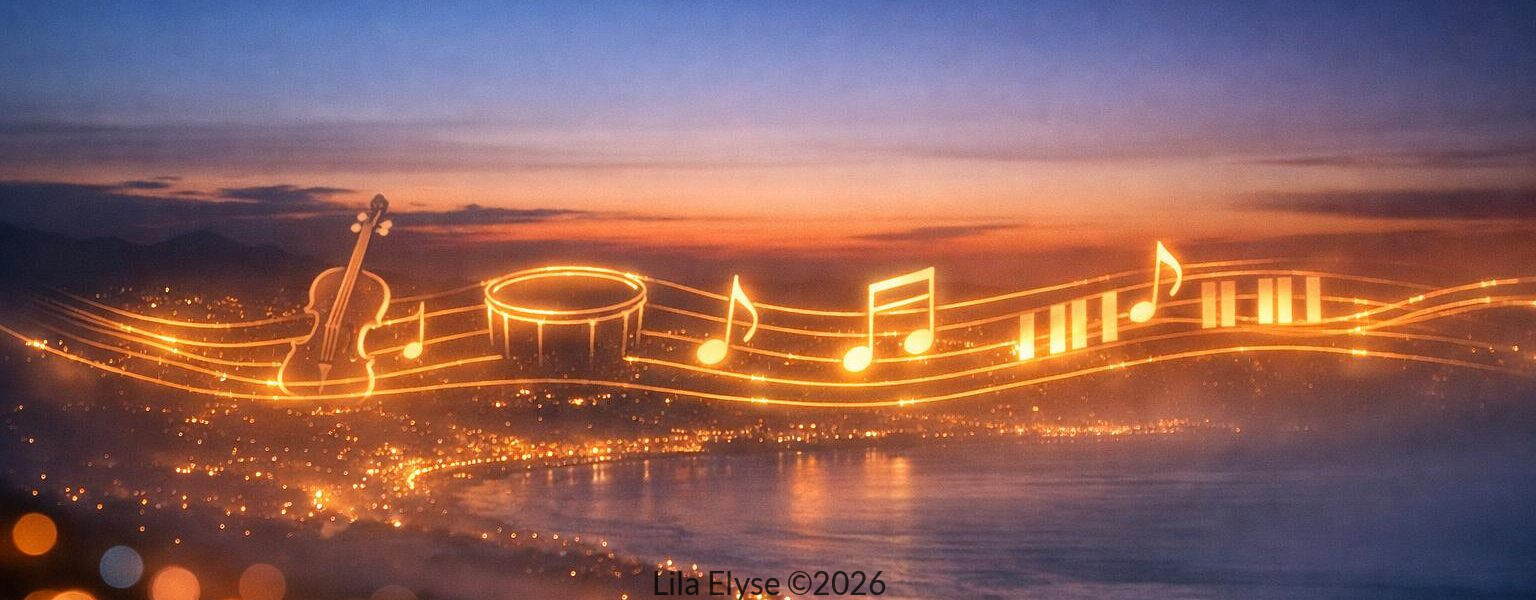
There is a sentence the world already knows, even before words arrive. It plays in the air between us. You can hear it in a market at dusk, in a train carriage at midnight, in a quiet kitchen when the kettle clicks and the room breathes. It is music—spoken everywhere, understood by anyone who allows it in.

What I love is how music travels without a passport. It slips through closed rooms and opens them from within. It does not need a dictionary to make meaning. A single held note can say, I’m here. Two can say, Stay. And a chord can say, I remember you—even if we have never met.

Perhaps that is why we lean towards it in moments that are too delicate for explanation. Rhythm helps the body tell the truth when the tongue can’t. Harmony lets difference sit together without argument. Silence, used well, keeps a hand on the door—so feeling can step in or out with dignity.

I think of melodies as bridges. They arc over rivers of culture and time, carrying footsteps in both directions. You can cross them barefoot, unprepared, and still arrive somewhere you recognise. No asterisks. No disclaimers. Just a human shape in the air, becoming real as it reaches you.

There is kindness in the way music listens back. You give it your breath, and it returns something shaped to fit the space you have. Some songs enter like a companion who knows where to stand. Others arrive like weather, shift the light, and go. Either way, the room remembers.

When I sing, I’m not sending messages to be decoded. I’m offering a place to rest. The voice is a lantern; the song is the path it draws—faint at first, then clear enough to follow. Every performance teaches me again: music doesn’t persuade; it allows. It makes space for what was already waiting to be felt.

We often speak about universals as if they were blunt instruments, flattening the edges of experience. Yet music’s universality is careful. It doesn’t erase detail; it frames it. A rhythm from one shore can carry a story from another, and both remain intact. That is the miracle to me: not sameness, but meeting.

In a noisy era, attention is the rarest gift. Music earns it without shouting. It steadies the breath, invites the shoulders to fall, and lets the day step aside. Even a few bars can reset the horizon. Suddenly, the room stretches a little wider. Suddenly, we can hear ourselves.

This is why I return to it again and again—not merely to make sound, but to practice connection. To ask better questions without words. To hold a mirror that does not judge. To be part of a language that keeps speaking long after the speaker has gone quiet.

Everywhere, the same language. It waits in the pause before a note, in the soft lift of a drum, in the way a line resolves and you feel your body untie. Wherever you are as you read this, perhaps there is a small sound beside you now—the hum of a light, a distant engine, your own breath. Listen to how easily they begin to agree. Listen to how the world, for a moment, becomes one instrument.

The quiet turns, the brightening: evolutions of my music

Not every evolution announces itself. Some arrive like a shift in air, a soft reorientation, a different way of hearing the same sky. My music moves like that—quiet turns, then brightening—until the shape of it feels inevitable, as if it always meant to be this way.

At first, I was mostly text and pulse: words set against a clear, uncluttered rhythm, like a heart finding its earliest tempo. I held space for silence and let the lines breathe. The distance between words felt as important as the words themselves, the unsaid revealing the contour of feeling.

Then came tenderness in texture. I leaned into the grain of sound—the hushed edges of a note, the places where breath frays into air. Minimal elements began to carry more weight, and the palette grew softer, not smaller: warm synths like light under water; gentle pianos that refused to hurry; strings that lifted, then folded back into stillness. It wasn’t complexity I was after—it was listening more closely.

There were seasons of rhythm and seasons of drift. Some songs took to a steady step, a kind of luminous stride that made the body remember itself. Others surrendered to suspension: time stretched thin, emotion hanging there, unresolved and honest. I learned that momentum and stillness can be the same truth, wearing different clothing.

My voice has travelled too. It learned to trust the lower register, to stay near the ground and speak with quiet courage. It learned restraint—not absence, but intention. Some days I sing like an open window; other days, I am the window frame, holding what passes through. Each choice is a way to say: I’m here. I’m listening back.

Collaboration has been a mirror—one that doesn’t just reflect but gently shifts the angle of light. A shared ear can reveal pathways I hadn’t noticed, melodies waiting in the margins. I’ve found that a song is not a fixed room; it’s a house with many doors. With the right company, new thresholds appear.

Lately, I’m drawn to tender contrasts: the intimacy of one clear voice against a wide, cinematic hush; a small, true lyric set inside a spacious horizon. I’m interested in how a single note can hold a world, and how a chorus can feel like an exhale you didn’t realise you were holding. The work keeps asking for less and, in offering less, gives more.

There’s a quiet thread that stays the same, no matter how the sound turns: sincerity over spectacle. I don’t want to decorate feeling; I want to meet it. Every song is an encounter—between memory-that-isn’t-memory and the pulse of now; between intention and accident; between my own centre and the listener’s. If a piece lands gently and lives with you for a while—if it looks after you the way a soft light does at the end of the day—then it has done its work.

I think of these evolutions not as departures but as ripples from the same stone. The origin remains: a wish to hold emotion without trapping it, to let it move through and stay luminous. What’s ahead is not a destination but a deepening. I’m still listening for what wants to be heard, and leaving room for it to arrive.

Thank you for walking with me through these turnings—quiet, bright, and true.