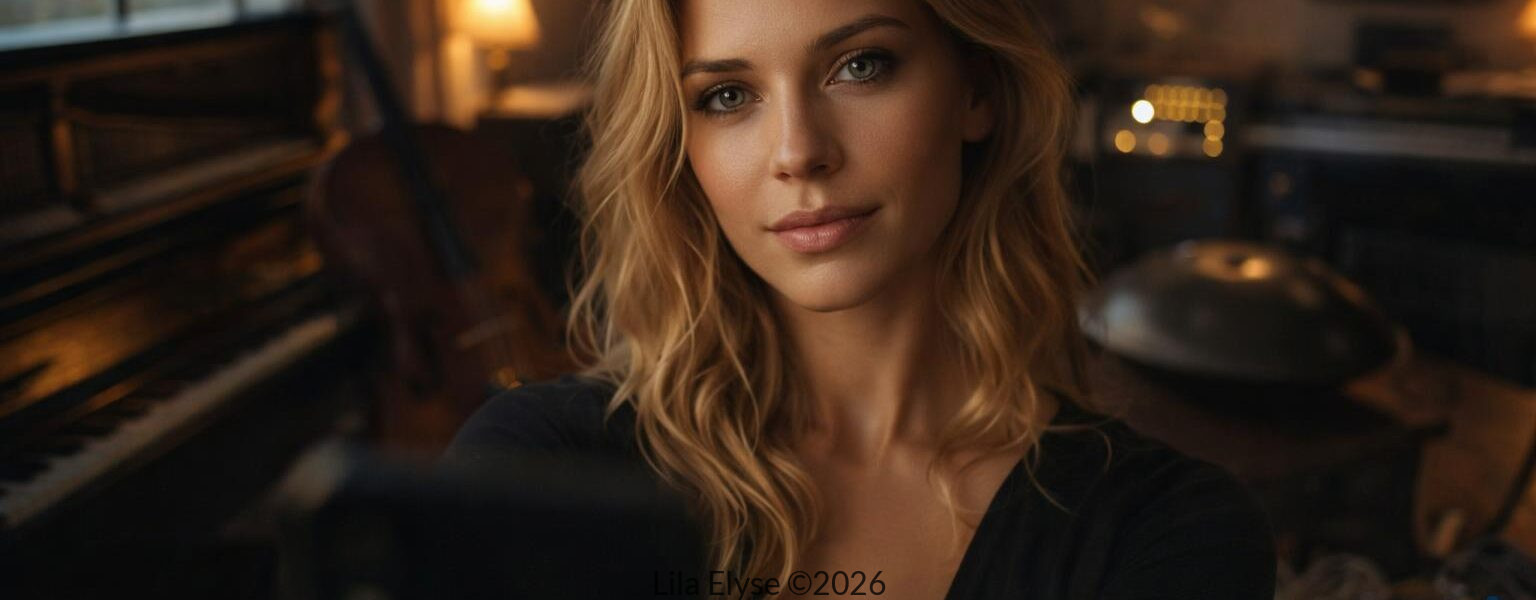
There are sounds I return to when a song is still a soft outline, not yet speaking but listening. Certain instruments feel like rooms I know how to inhabit—places where I can hear the air move and understand which way the feeling wants to travel. They aren’t props to decorate a melody; they are companions. They help me notice what the song is asking for.
Piano is my first doorway. Not the showy kind—the quiet, honest one. A piano keeps time with the heart rather than the clock. Its weighted keys remind me that melody is a kind of gravity: each note falling into its own moment, nothing rushed, nothing withheld. I love the space it creates between touch and bloom, the way a chord can hold a thought steady just long enough for it to become true.
Cello is breath turned into amber. It begins where the voice deepens and the body sighs. When a song needs warmth without sentimentality, I reach for that tenor earth—the long, human arc of a bowed line that can carry grief and grace in the same gesture. Cello doesn’t cry; it consoles. It draws a horizon and gently widens it.
Voice is the instrument that chose me. Not only the sung line, but the near-whisper, the held note, the exhale. Sometimes the most faithful harmony is a second version of the self, tucked an octave below or above, tracing the melody like a hand on a shoulder. Stacked and soft, voices become weather. They can clear a sky or invite the rain.
Nylon-string guitar offers intimacy without spectacle. The pads of the fingers know what the ear needs: closeness, texture, the slight imperfection that makes the line feel alive. I favour open tunings that loosen the room, letting harmonies drift to where they naturally want to settle. It’s a kind instrument—generous with space, never impatient.
Rhodes feels like dusk. Its tone is candlelight on water—gentle, a little electric, quietly undeniable. When a song needs tenderness with a spine, I sit with those rounded tines until they start to hum in the right place. A simple voicing can change the temperature of the entire piece.
Harp is a constellation. I don’t need it often, but when I do, it’s for clarity—stars pricked into a dark sky. Arpeggios become architecture. The space between notes becomes a kind of listening. A single, deliberate glissando can tilt a feeling from doubt to devotion.
I adore the patience of a handpan. It teaches restraint. Each strike blooms and asks you to wait, to let the circle of resonance finish speaking. Patterns become meditation; silence carries equal weight. When rhythm must feel like touch rather than tap, the handpan understands.
Then there’s the quiet theatre of modular synth—sound as sculpture. I don’t treat it as a machine, but a garden: signals winding through gates, blooming, folding, arriving changed. When a song needs a pulse that feels alive, I let the patch breathe on its own for a while, then invite it to meet the melody halfway. The imperfections are the point.