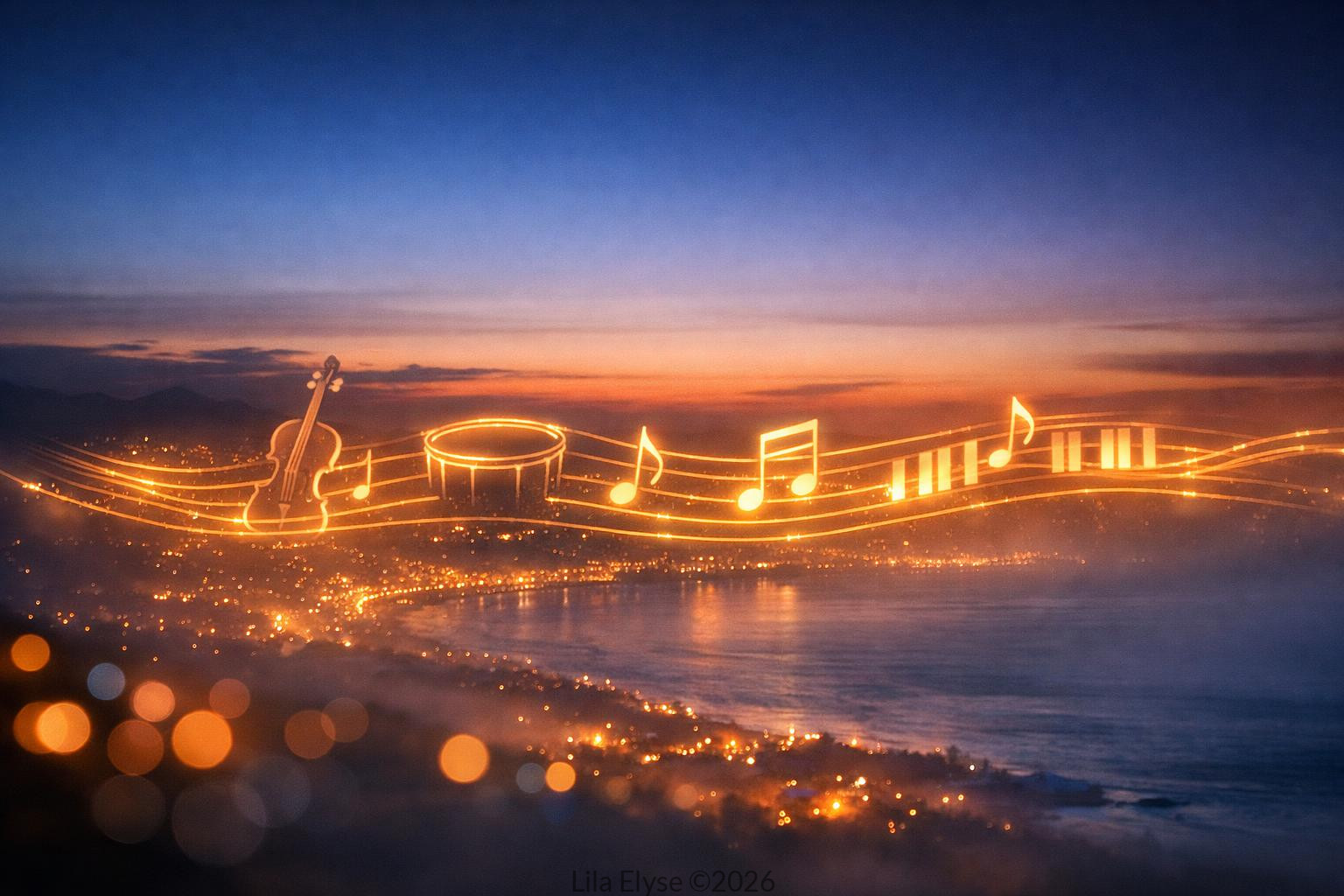
There is a sentence the world already knows, even before words arrive. It plays in the air between us. You can hear it in a market at dusk, in a train carriage at midnight, in a quiet kitchen when the kettle clicks and the room breathes. It is music—spoken everywhere, understood by anyone who allows it in.
What I love is how music travels without a passport. It slips through closed rooms and opens them from within. It does not need a dictionary to make meaning. A single held note can say, I’m here. Two can say, Stay. And a chord can say, I remember you—even if we have never met.
Perhaps that is why we lean towards it in moments that are too delicate for explanation. Rhythm helps the body tell the truth when the tongue can’t. Harmony lets difference sit together without argument. Silence, used well, keeps a hand on the door—so feeling can step in or out with dignity.
I think of melodies as bridges. They arc over rivers of culture and time, carrying footsteps in both directions. You can cross them barefoot, unprepared, and still arrive somewhere you recognise. No asterisks. No disclaimers. Just a human shape in the air, becoming real as it reaches you.
There is kindness in the way music listens back. You give it your breath, and it returns something shaped to fit the space you have. Some songs enter like a companion who knows where to stand. Others arrive like weather, shift the light, and go. Either way, the room remembers.
When I sing, I’m not sending messages to be decoded. I’m offering a place to rest. The voice is a lantern; the song is the path it draws—faint at first, then clear enough to follow. Every performance teaches me again: music doesn’t persuade; it allows. It makes space for what was already waiting to be felt.
We often speak about universals as if they were blunt instruments, flattening the edges of experience. Yet music’s universality is careful. It doesn’t erase detail; it frames it. A rhythm from one shore can carry a story from another, and both remain intact. That is the miracle to me: not sameness, but meeting.
In a noisy era, attention is the rarest gift. Music earns it without shouting. It steadies the breath, invites the shoulders to fall, and lets the day step aside. Even a few bars can reset the horizon. Suddenly, the room stretches a little wider. Suddenly, we can hear ourselves.
This is why I return to it again and again—not merely to make sound, but to practice connection. To ask better questions without words. To hold a mirror that does not judge. To be part of a language that keeps speaking long after the speaker has gone quiet.
Everywhere, the same language. It waits in the pause before a note, in the soft lift of a drum, in the way a line resolves and you feel your body untie. Wherever you are as you read this, perhaps there is a small sound beside you now—the hum of a light, a distant engine, your own breath. Listen to how easily they begin to agree. Listen to how the world, for a moment, becomes one instrument.